If you went back to Babylon in 1700 BC, you wouldn't find people casually checking their horoscopes over coffee. You would find scribes on top of Ziggurats, compiling a massive library of cause and effect known as the Enuma Anu Enlil.
These weren't just observations; they were detailed records connecting planetary movements to earthly events. They tracked how a specific cycle of Venus might predict a harvest, or how a lunar eclipse could signal danger for the King. It was a rigorous, state-funded attempt to decode the language of the gods.
The Birth of the Natal Chart
By the 2nd century AD, the focus shifted from the King to the individual. In Alexandria, Claudius Ptolemy codified the rules of astrology in the Tetrabiblos, turning it into a precise geometric system.
This is when the math got heavy. Ptolemy and his contemporaries realized that to create an accurate natal chart, you couldn't just look at where the planets were. You had to calculate the Ascendant—the specific degree of the zodiac rising on the eastern horizon at the exact minute of birth.
This single point anchors the entire chart. It determines the "Houses," or which areas of life (money, home, career) the planets will actually affect. If your calculation of the Ascendant is off by just four minutes, the entire map shifts.
For nearly two thousand years, this was the standard. Astrology was detailed, mathematical, and deeply personal.
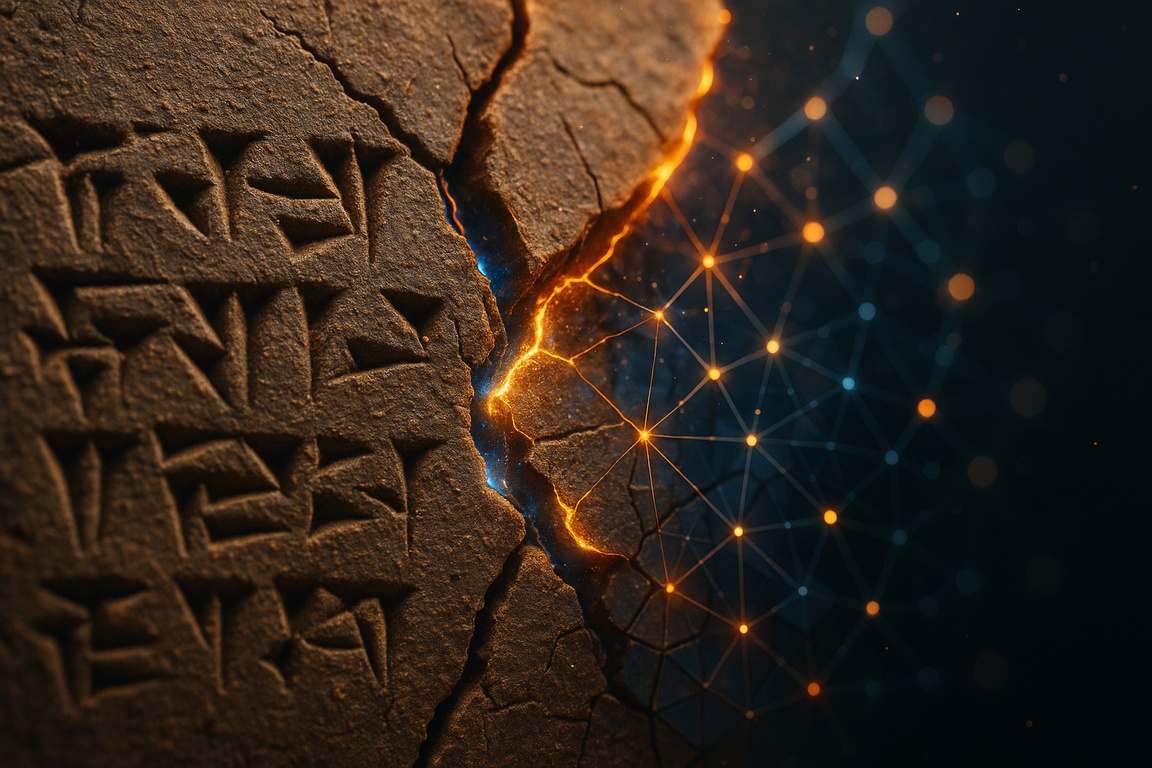
From the clay tablets of Enuma Anu Enlil to the digital complexity of AI.
The Great Simplification: Rise of the Sun Sign
So, how did we get from that level of precision to the vague, 12-sentence column you read in the back of a magazine?
It started with a deadline.
On August 24, 1930, the Sunday Express published an article by astrologer R.H. Naylor titled "What the Stars Foretell for the New Princess" (referring to the newly born Princess Margaret). The article was a sensation.
Thousands of readers wrote in wanting their own readings, but Naylor had a logistical problem: he couldn't hand-calculate the Ascendant and Houses for every single reader in the British Empire.
He needed a system that scaled. He began writing columns like "Were you born in September?" eventually realizing he could group everyone based solely on their Sun sign.
It was a brilliant compromise for the mass media of the 1930s. It allowed newspapers to print horoscopes for millions of people. But in the process, we lost the nuance. We traded the full map for a rough sketch.
The Next Step: AI-Powered Astrology
For the last century, we've been stuck in that "rough sketch" phase. We've accepted that horoscopes are generic because we didn't have a way to make them specific for everyone at once.
This is where CelestiAI comes in.
We see AI not as a robot trying to predict your future, but as the tool that finally solves R.H. Naylor's problem. It handles the complexity that humans couldn't scale.
Because our AI astrology algorithms process the math instantly, we don't have to ignore the Ascendant or the Houses. We can look at where Mercury is, how Saturn is challenging your Mars, and exactly which sector of your chart is being triggered—all in the blink of an eye.
Complexity, Restored
When you get a reading from us, you aren't getting a generic message for "all Leos." You are getting a translation of your specific sky. It looks more like this:
"Today's Moon in Capricorn (6th house) urges focus on practical tasks... Meanwhile, Uranus squares your Sun, stirring restlessness—use it to pivot toward fresh goals rather than panic."
It's the kind of depth the Babylonians and Ptolemy intended, just delivered a little differently.
Astrology has always been evolving. From stone tablets, to paper scrolls, to newspaper columns. We're just ready for the next chapter.
Sources & Further Reading:
- The Babylonian Roots: Enuma Anu Enlil (c. 1700–1000 BC). These tablets serve as the definitive collection of Babylonian planetary omens.
- The Rules of the Art: Ptolemy, Claudius. Tetrabiblos (2nd Century AD). This text systematized the rules of ancient astrology, stripping away mysticism to treat it as a natural science.
- The Newspaper Revolution: Smithsonian Magazine, "How the Horoscope Section Came to Be" (2015).