We’ve all seen the Christmas cards. A single, blindingly bright star hangs low over a stable, looking a bit like a celestial flashlight pointing the way. It’s a beautiful image. But if you look at the history of astronomy, that picture doesn't quite add up.
If a star that bright had suddenly appeared in the sky, the ancient world from China to Rome would likely have documented it. Yet, outside of the biblical narrative, the historical record is quiet. There is no mention of a singular exploding star (nova) or comet matching the description in Matthew during that specific window of time.
This leads many historians and astronomers to a different conclusion. The Star of Bethlehem might not have been a star at all. One of the most plausible astronomical explanations is that it was a planetary alignment. This event might not have looked like much to a casual observer, but it would have been deeply significant to a trained priest-astrologer.
Who Were the Magi?
To understand the astrology, we have to look at the people in the story. Historians still debate whether specific individuals made the trek to Bethlehem. As noted by biblical scholars, the story appears only in the Gospel of Matthew and is not found in Roman records or the writings of Josephus.
However, the Magi themselves were a real group.
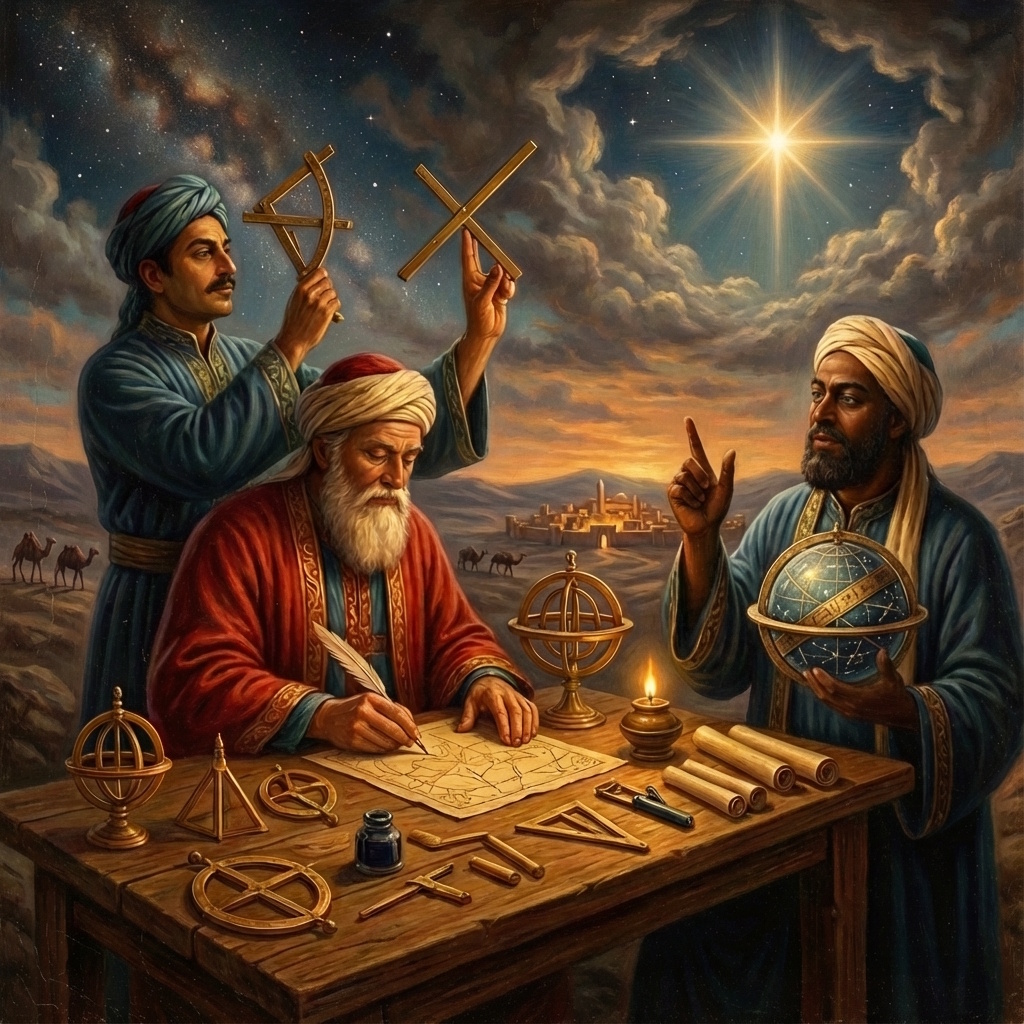
As documented by the Greek historian Herodotus in the 5th Century BC, the Magi were a priestly caste of the Persian Empire. Later traditions associate them with wisdom, dream interpretation, and astronomy. In the ancient world, observing the heavens was often part of a priest’s duty. They tracked the "wandering stars" (planets) against the fixed constellations, looking for correlations between the heavens and earthly events.
If we look at the sky during that era through their eyes, what might have been significant enough to inspire the narrative?
The Leading Theory: The Great Conjunction of 7 BC
While there are several theories, the one that has intrigued astronomers for centuries involves a complex relationship between Jupiter and Saturn. This theory was championed by Johannes Kepler in the early 17th century, and modern math confirms the alignment happened.
In 7 BC, a rare series of conjunctions occurred. Jupiter and Saturn met in the sign of Pisces. But they didn't just meet once. Because of retrograde motion, where a planet appears to move backward in the sky from our perspective, these two giants met three separate times over the course of several months.
Why would this matter? In the language of ancient astrology, specific meanings were assigned to these bodies:
- Jupiter: Known as the "Great Benefic," the planet of kingship.
- Saturn: The planet associated with structure, time, and history.
- Pisces: In some strands of ancient astrological geography (chorography), the sign associated with the region of Syria and Judea.
If we overlay these symbolic associations, a powerful narrative emerges that some modern interpreters see in this alignment. It wasn't just a general omen; it becomes a kind of map:
A King (Jupiter) of History (Saturn) is appearing in the land of Judea (Pisces).
Why the "Triple" Conjunction Matters
The fact that they met three times in one year is the key. A single conjunction happens roughly every 20 years. But a triple conjunction is much rarer.
It created a prolonged astrological narrative that lasted for months. As noted by astronomer David Hughes, this timeline roughly fits the narrative in Matthew. It explains why a "star" could be seen in the East, disappear, and then reappear later. It wasn't a single static object; it was a planetary dance unfolding over time.
The Venus Connection (3-2 BC)
There is another compelling theory for those who prefer a brighter visual spectacle, though it relies on a contested timeline. Some historians, like Dr. Ernest Martin, argue that King Herod died later than usually accepted (1 BC rather than 4 BC). This shifts the birth of Jesus to 3 or 2 BC.
During this window, Jupiter and Venus engaged in a series of conjunctions. In June of 2 BC, they moved so close together that, to the naked eye, they would have appeared to merge into one single, dazzlingly bright "star." This fits the visual description of a bright light better, though the 7 BC Jupiter-Saturn alignment remains the favorite for those focusing on symbolic meaning.
Reading the Whole Sky
Whether the Magi were historical figures or characters in a theological drama, the story reminds us that the sky has always been a narrative. The "Star" wasn't a single magic object; it was a conversation between the planets.
Sources & Further Reading:
- The Birth of the Messiah by Raymond E. Brown (1977) – A definitive scholarly analysis of the gospel infancy narratives.
- The Star of Bethlehem: An Astronomer's Confirmation by David Hughes (1979) – For a detailed look at the 7 BC Triple Conjunction theory.
- The Star that Astonished the World by Dr. Ernest Martin (1991) – For the argument regarding the Venus/Jupiter conjunctions (note: this timeline relies on a minority view of Herod's death).
- The Histories by Herodotus – For historical context on the Magi priesthood.
- De Stella Nova by Johannes Kepler (1606) – The original calculation of the conjunction theory.